Showing posts with label Federal. Show all posts

Department of Education Releases Annual IDEA Report to Congress

Last week, the U.S. Department of Education issued the 41st Annual Report to Congress on the Implementation of the Individuals with Disabilities Education Act (IDEA).

Since its enactment, IDEA has required an annual report to inform Congress and the public about implementation of the law in four main domains:
  • providing a free and appropriate public education (FAPE) for students with disabilities and early intervention for infants and toddlers,
  • ensuring that the rights of students with disabilities and their parents are upheld,
  • assisting states and localities to provide IDEA services to all students with disabilities, and
  • assessing the effectiveness of efforts to provide IDEA services.
Key findings [from 2017 state-reported data] include:
  • 2 percent of special education teachers providing special education and related services for students aged 3 through 5 were highly qualified.
  • 9 percent of special education teachers providing special education and related services for students aged 6 through 21 under IDEA Part B were highly qualified.
  • 9 percent of students ages 6 through 21 served under IDEA Part B were educated in the regular classroom for at least some portion of the school day.
  • In Illinois, we are serving 11 percent more students now (2017) than we were in 2008.
Click here to download the report.

Federal Budget Update

Nearly three months after the start of Fiscal Year (FY) 2020, Congress and the White House have reached an agreement on spending bills and begun to move forward with approving the measures. The 12 spending bills have been broken into two packages, or “minibuses.” The deal honors the $49 billion in increased funding that was agreed to under a bipartisan budget deal signed into law in July. Education spending will get a $1.3 billion increase, reaching a total of $72.8 billion in discretionary funding for the U.S. Department of Education (ED).

All of the programs that CASE and CEC advocates on behalf of saw an increase. Details are as follows:
  • Individuals with Disabilities Education Act (IDEA) Grants to States Program (Part B) will receive a $400 million increase, for a total of $12.76 billion.
  • IDEA Infants and Toddlers with Disabilities Program (Part C) will receive a $7 million increase, for a total of $477 million.
  • IDEA Preschool Program (Part B Section 619) will receive a $3 million increase, for a total of $394 million.
  • IDEA National Activities (Part D) will receive a $6.5 million increase, for a total of $250 million.
  • National Center for Special Education Research, within the Institute for Education Sciences will receive a $500,000 increase, for a total of $56.5 million.
  • Title I will receive a $450 million increase for a total of $16.3 billion in funding.
  • Title II-A will receive an increase of $76 million for a total of $2.1 billion in funding.
  • Title IV-A will receive an increase of $40 million for a total of $1.2 billion in funding.
Additionally, the bill includes language that instructs the ED and other agencies on matters pertaining to CASE and CEC’s policy priorities. A few examples are:

Jacob K. Javits Gifted and Talented Program: Congress requests ED to use funds to “increase the number of grants that assist schools in the identification of, and provision of services to, gifted and talented students who may not be identified and served through traditional assessment methods, such as children with disabilities, English learners, children of color, and economically disadvantaged students.”

Special Education Teacher Shortages: Congress requests a report from the Government Accountability Office on “…factors contributing to school districts' challenges with teacher recruitment and retention.” The report is to also include a review and analysis of challenges with recruitment and retention of “special education teachers, paraprofessionals, and teacher aides; the extent to which licensure requirements are waived or modified to address shortages; and geographic and demographic characteristics of districts facing the greatest challenges or shortages, including rural and urban areas,” and to make recommendations on “potential Federal interventions to improve teacher recruitment and retention.”

Medicaid: Congress advises the Office of Special Education and Rehabilitative Services to coordinate with the Centers for Medicare and Medicaid Services to provide technical assistance to reduce administrative barriers for providing health services in coordination with schools.

On Tuesday, the U.S. House of Representatives advanced the two minibuses. The Senate is expected to clear the spending measures and President Trump is expected to sign them into law before the current spending deal expires at midnight on December 20.

Congratulations to the field for its continued pressure on appropriators to increase spending for students with exceptionalities. Your ongoing advocacy is critical, and we thank you for your hard work.

Read the Labor-H bill here.
Read the Labor-H report here.

ACTION: Federal Funding Call In Days - Thursday and Friday

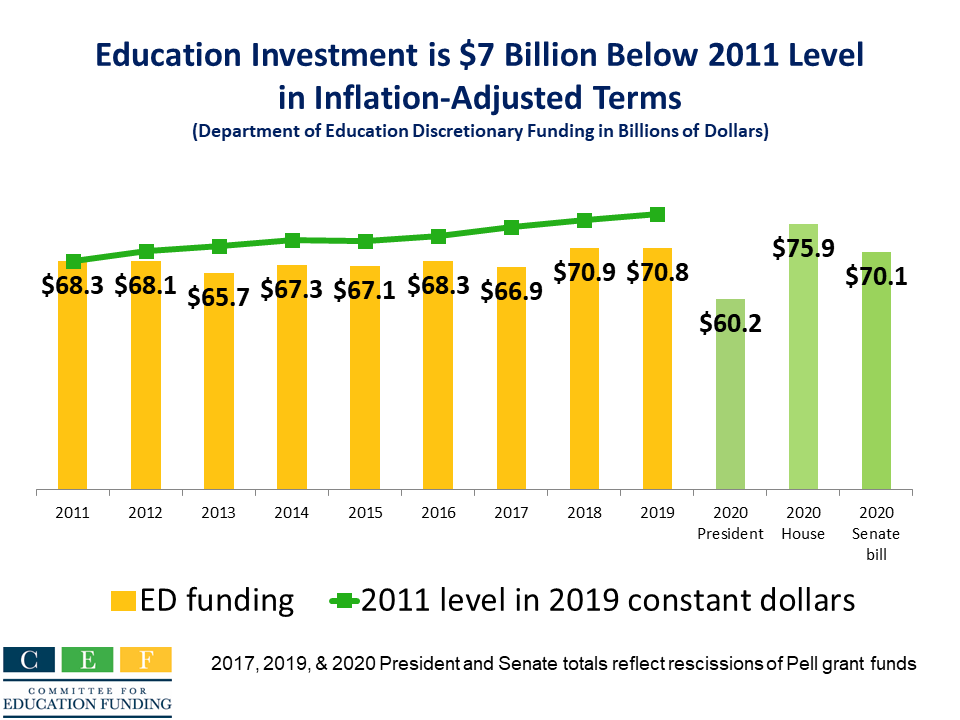
CASE is a member of a coalition, Committee for Education Funding (CEF) and they are wanting all of our members to call the House on Thursday, Dec 5 and the Senate on Dec 6. There are several great resources from them for you to use. Script and directions, and Twitter addresses. I have also added images on Education Funding Chart and Poll on Public opinion that may be helpful. At a minimum, you should call in to the House and Senate, but it would be really great if you could at least get your executive committee/board/officers to do the same!

ACTION NEEDED: Federal Appropriations

Last week, the U.S. Senate made the first procedural move to advance a number of non-controversial spending measures for Fiscal Year (FY) 2020 as early as this week. At the moment, the grouping, or "minibus," includes Commerce, Justice, Science; Agriculture; Interior and the Environment; Transportation, Housing and Urban Development; and Military Construction, Veterans Affairs. While those bills are taking center stage, we learned that negotiations are active behind the scenes on the Labor, Health and Human Services, Education, and Related Agencies (Labor-H) bill, which includes federal funding for education programs. A current likely scenario [in a fast-changing climate] is that the top-line number for the Labor-H bill will land somewhere between the Senate's level-funding approach and the House's proposed major increase, leaving some additional money for FY 2020. The most likely outcome is that the bulk of extra Labor-H funding would go toward the National Institutes of Health. Any other excess could go toward education and may likely increase the major formula grants to states, including special education.

CEC has developed a Call to Action so members can engage in a final push on FY 2020 spending through a letter-writing campaign. The template letter calls for spending increases to the following programs:
  • Individuals with Disabilities Education Act (IDEA) Grants to States Program (Part B)
  • IDEA Infants and Toddlers with Disabilities Program (Part C)
  • IDEA Preschool Program (Part B Section 619)
  • IDEA National Activities (Part D)
  • National Center for Special Education Research, within the Institute for Education Sciences
To join in this call to action, please follow this link.

Tell Congress to Cosponsor - Funding Early Childhood is the Right IDEA Act (H.R. 4107)

This summer, Congressman Mark DeSaulnier (D-CA) and Congressman Rodney Davis (R-IL) introduced the Funding Early Childhood is the Right IDEA Act (H.R. 4107), a bipartisan bill to restore full funding for education and services for children with disabilities. This bill runs parallel to the widely supported bipartisan, bicameral IDEA Full Funding Bill (H.R. 1878). H.R. 4107 has 51 associations and organization that have pledged their support for the measure.

Currently, IDEA Part C and Section 619 Preschool Programs serve over 1.16 million children. The bill includes authorization levels for IDEA Part C and Section 619 Preschool Grant Programs and authorizes a five year glide path to full funding. During the Special Education Legislative Summit (SELS) advocates informed their members of Congress about the state of early intervention and preschool special education programs in the nation and urged them to cosponsor the bill to ensure that young children receive the services necessary for improved educational, behavioral and developmental outcomes. The Division of Early Childhood (DEC) Executive Director, Peggy Kemp applauds the bill and was quoted in Representative DeSaulnier’s H.R. 4107 press release saying, “Fully funding these programs under IDEA is essential to ensuring high-quality services for young children birth through five years with disabilities and their families. We are fully committed to working with these IDEA champions to make these funds a reality.”

Visit CEC’s Legislative Action Center to urge your member of the U.S. House of Representatives to prioritize the needs of young children with disabilities and their families and cosponsor H.R. 4107. Take action today!

Update on Significant Disproportionality - Court Rules Against Department of ED

CASE has been hard at work on behalf of its members on the issue of disproportionality.  After gathering feedback at the Board of Directors meeting in November, CASE submitted comments regarding the issue to Johnny Collett, the Assistant Secretary for the Office of Special Education and Rehabilitative Services (OSERS).  Many of you completed the survey we sent out and our Significantly Disproportionality Ad Hoc committee is taking all of that into consideration. 

Meanwhile, on Thursday, March 7, the US District Court for the District of Columbia announced its decision ruling the US Department of Education engaged in "illegal delay." CASE did immediately released a statement concerning this development.   
We are committed to continue working together on this very important issue through our AD HOC committee to figure out next steps for our members across the country. 

Here is an article from our legislative consultant that may help to clarify! 

Court Rules Regulation Delay Violates Federal Law
Myrna Mandlawitz, CASE legislative Consultant
Implementation of a 2016 regulation related to significant disproportionality in special education, promulgated by the U.S. Department of Education at the end of the Obama Administration, was put on hold by the current Administration in early 2017. The regulations would require states and local school districts to examine, report on, and address disproportionate identification and placement into more restrictive settings of students of color, as well as examining disciplinary actions for students with disabilities, including higher rates of suspension and expulsion.
After delaying the original regulation, the Department initially said it would issue a new proposed regulation in February 2019. That date came and went. While waiting for Department action, in July 2018 the Council of Parent Attorneys and Advocates (COPAA), represented by the National Center for Youth Law, filed suit against the Department of Education alleging the Department's delay violated the Administrative Procedure Act (APA). Specifically, the suit alleged the Department had taken actions that interfere with its obligation under the Individuals with Disabilities Education Act (IDEA) to ensure students with disabilities receive needed education services in the most appropriate setting without regard to students' race.
The U.S. District Court for the District of Columbia announced its decision on March 7, ruling the U.S. Department of Education engaged in "illegal delay of a legal regulation." The court's ruling requires immediate implementation of the original regulations. Interestingly, a number of states continued to move toward implementation of the 2016 regulation, even though the Department suspended the regulation, so many states will not to have change their current activities.
In a letter to Assistant Secretary of the Office of Special Education and Rehabilitative Services (OSERS) on April 15, 2018, CASE stated "we strongly support addressing the issue of significant disproportionality, with special education eligibility as one factor. However, we also recognize this is a much larger systemic education issue that cannot be resolved solely through these regulations. That said, we are aware several states have made significant progress toward implementing these rules, with the original deadline close at hand. We do not want states that have followed the timetable to be penalized, while those that did not plan for the deadline are allowed greater flexibility than those that did. In addition, we believe delay may cause greater confusion in the field and continued wide variability in practice, exactly what these regulations are designed to avoid."
We are now waiting to see if the Department of Education will appeal the decision, or what their next move will be regarding this important regulation. In fact, this decision could have farther reaching consequences, since the Department has been moving to roll back other regulations across the various education programs they administer. It will be interesting to see if other organizations or stakeholders challenge other regulatory actions.
You can read the full decision in Council of Parent Attorneys and Advocates, Inc. v. DeVos, Collett, U.S. Department of Education at https://ecf.dcd.uscourts.gov/cgi-bin/show_public_doc?2018cv1636-31.

IAASE Members Encouraged To Register for CASE/CEC Special Education Legislative Summit

Special Education Legislative Summit Banner
|
|

2019 Special Education Legislative Summit


The Council for Exceptional Children (CEC) and Council of Administrators of Special Education (CASE) invite you to the 2019 Special Education Legislative Summit, the premier advocacy event of the year for special educators and early interventionists.

During this event, advocates from across the country gather to educate our nation’s policymakers about:
  • Protecting and increasing IDEA funding for its intended purpose.
  • Ensuring no policy restricts public education’s ability to deliver a free appropriate public education and early intervention services.
  • Safeguarding the rights of children and youth with exceptionalities.
You know what children and youth with exceptionalities and professionals need, so raise your voice and advocate with us during the 2019 Special Education Legislative Summit this July!

Hurry to register at Early Bird rates!

Be an advocate!
Council for Exceptional Children
2900 Crystal Drive, Suite 100
Arlington, VA 22202

Department of Education and Department of Justice Withdraw "Rethink School Discipline" Package

US Department of Education
Dear Colleague:
The purpose of this letter is to inform you that the Department of Justice and the Department of Education are withdrawing the statements of policy and guidance reflected in the following documents:
  • Dear Colleague Letter on Nondiscriminatory Administration of School Discipline dated January 8, 2014; and
  • Overview of the Supportive School Discipline Initiative dated January 8, 2014.
Additionally, the Department of Education is withdrawing the following related documents:
  • Guiding Principles: A Resource Guide for Improving School Climate and Discipline,dated January 8, 2014;
  • Appendix 1: S. Department of Education Directory of Federal School Climate and Discipline Resources, dated January 8, 2014;
  • Appendix 2: Compendium of School Discipline Laws and Regulations for the 50 States, Washington D.C., and Puerto Rico, dated January 8, 2014; and
  • School Discipline Guidance Package FAQs, dated January 8, 2014.

The Dear Colleague Letter on Nondiscriminatory Administration of Discipline (“Guidance”) discussed the legal framework that the Departments employ to analyze complaints of discrimination under Title IV of the Civil Rights Act of 1964 (Title IV), 42 U.S.C. §§ 2000c et seq., and Title VI of the Civil Rights Act of 1964 (Title VI), 42 U.S.C. §§ 2000d et seq., and its implementing regulations, 34 C.F.R. Part 100. Title IV authorizes the Attorney General in certain circumstances to institute a lawsuit against public school boards, colleges, and universities upon receiving a complaint of discrimination. Title VI prohibits discrimination based on race, color, or national origin by recipients of Federal financial assistance. The Guidance presented and analyzed, under Titles IV and VI, a number of factual scenarios involving the application of school discipline, and indicated what conclusions the Departments might reach in each scenario.
On March 12, 2018, President Trump announced the formation of a Federal Commission on School Safety.  President Trump directed the Commission to study and make recommendations regarding several issues, including whether the Guidance and associated documents should be rescinded.  On December 18, 2018, the Commission recommended that the Departments rescind the Guidance and associated documents. 
States and local school districts play the primary role in establishing educational policy, including how to handle specific instances of student misconduct and discipline, and in ensuring that classroom teachers have the support they need to implement appropriate discipline policies.  States and local school districts must also comply with the anti-discrimination protections contained in federal law, including Title VI.  The Departments have concluded that the Guidance and associated documents advance policy preferences and positions not required or contemplated by Title IV or Title VI.  
Accordingly, the Department of Education and the Department of Justice have decided to withdraw and rescind the Guidance and associated documents. The Departments are firmly committed to vigorously enforcing civil rights protections on behalf of all students.  The robust protections against race, color, and national origin discrimination guaranteed by the Constitution, Title IV, and Title VI remain unchanged, and continue to be vital for educational institutions in the United States.
This letter does not add requirements to applicable law and is not intended to, and does not, create any rights, substantive or procedural, enforceable at law by any party in any matter civil or criminal.  If you have questions or are interested in commenting on this letter, please contact the Department of Education at ocr@ed.gov or 800-421-3481 (TDD: 800-877-8339); or the Department of Justice at education@usdoj.gov or 877-292-3804 (TTY: 800-514-0383). 

Sincerely,

/s/                                                                              /s/
Kenneth L. Marcus                                                    Eric S. Dreiband
Assistant Secretary for Civil Rights                         Assistant Attorney General
U.S. Department of Education                                  U.S. Department of Justice